Five months. Weekly 1-2-1 coaching. An entrepreneur who stopped performing. And started being himself.
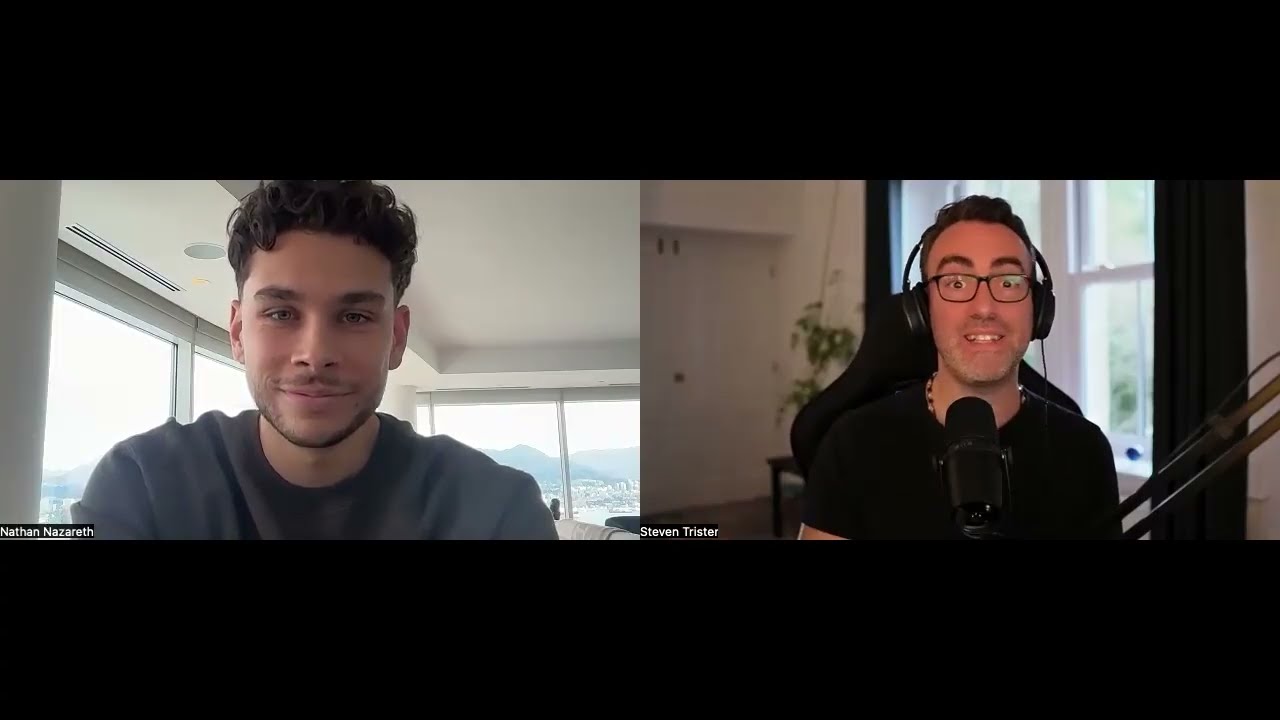
↓ Click the image below to watch the full case study video
once you click the button, you'll be taken to WhatsApp to message Steven directly
How an entrepreneur, YouTuber and investor went from reverse-engineering other people's styles to unlocking his own voice - and having his audience notice the difference live.
together
coaching sessions
YouTuber & Investor
& Day Nathan's own words
on the transformation
He had a talented team, great content, and a growing audience. But he knew something was still missing.
Nathan Nazareth is an entrepreneur, YouTuber and investor with 951k followers on Instagram and 596k subscribers on YouTube. He has editors, scriptwriters, and a team helping him across every part of his production process. By most measures, things were working. Views were coming in. Accounts were growing.
But Nathan is the kind of person who sits back and asks the harder question. Not just how things are going. But what he could specifically do to push things further - and whether he was truly operating at his ceiling.
When he did that, the answer became obvious. He'd invested heavily in everything around him. The editing. The scripting. The packaging. But there was one lever he hadn't pulled. The one thing only he could control.
His delivery.
He started sifting through his network looking for a speaking coach. A connection in the YouTube space pointed him to Steven. A call was booked within a day or two. By the end of that first call, Nathan had signed up. Paid in full. No hesitation.
Your ability as a speaker was like, okay, that's the guy. The way you were talking to me on that call was the level I wanted to get to when I'm on calls or delivering presentations.
Nathan Nazareth - on the discovery call with StevenThe delivery could improve. But there was a deeper issue underneath it.
It became clear a few months into working together that the technical side of speaking - honouring words, presence, emotional range, pacing - could only take Nathan so far. Not because the tools weren't working. They were. He was improving. But something wasn't fully clicking.
What was happening
Nathan's entire approach to content had been built around reverse-engineering the people ahead of him. Dissecting what worked. Finding the patterns. Emulating them. Logical. Data-driven. Efficient. And on one level, effective. But in doing so, he had been creating as someone else - a polished version of what success looked like, not an expression of who he actually was.
Why it mattered
You can learn every delivery tool in the book. But if you're using them to portray a persona that doesn't feel true to you, there's a ceiling. The tools can only unlock your full range if you're willing to actually be yourself inside them. Nathan had been performing Nate 1.0. A well-executed mimicry of everyone else.
The insight: The technical side of delivery and the personal side are inseparable. You can't fully express what you haven't yet decided to be. For Nathan, the speaking work wasn't just unlocking better delivery. It was holding up a mirror.
It wasn't a technique that changed things. It was one conversation.
A few months in, progress was clear. Nathan was absorbing everything. Showing up week after week. Putting the reps in. But there was a particular session - one that had nothing to do with gestures or eye contact or vocal variety - where something shifted.
It was a deep conversation. The kind where you can see someone's brain turning in real time. Steven watched it happen. Nathan confronted something he had been circling around without fully naming: that he didn't want to stay in the box. That Nate 1.0 - the polished, data-driven emulator of other successful creators - wasn't who he actually wanted to be anymore.
That realisation changed everything. Not because it unlocked a new technique. But because it changed the context in which every technique now lived. Once Nathan decided he was going to show up as himself - and only himself - the tools had somewhere real to go.
That shift is not something a coach gives a client. It's something a coach creates the conditions for. The weekly sessions, the accumulation of work, the safe space to look honestly at how he was showing up - all of that is what made the moment possible.
It clicked all at once. It wasn't just the brain. It was everything. It was the soul stirring. That had to come from within you. There was no way I could have ever forced that.
Steven Trister - on that sessionFive months of weekly sessions. Nothing passive about any of it.
This isn't a course. It's not a programme with a fixed syllabus. The work happened weekly, in real time, shaped by where Nathan actually was as a creator and as a person.
Honouring the words
Nathan learned to treat the words in a script not as information to convey but as something worth inhabiting. Which words matter most in a sentence. Where to slow down. Where the emotional register has to shift. It's a fundamentally different relationship with language.
Expanding the emotional range
Creators who've spent years optimising for what works tend to flatten their delivery. Nathan worked on accessing more: curiosity, warmth, weight, levity. Not performance. Range that came from actually feeling it, not producing it.
Presence and being in the moment
The mind that's thinking about the next sentence is not the mind that's landing this one. A significant part of the work was learning to be fully present in a take - to stop splitting attention between content and delivery and let both happen at once.
Accessibility over complexity
Nathan had a tendency - common among high-performers - to use elevated vocabulary as a proxy for depth. He learned that the most compelling communicators make the complicated simple, not the other way around. Delivery that reaches more people isn't dumbed down. It's disciplined.
Storytelling and holding an audience
Nathan came in wanting to do what the best in his space all do: captivate an audience, hold them there, and make the boring and mundane genuinely exciting. That's not a personality trait. It's a craft. One that got built deliberately, session by session.
Real reps, in real content
Unlike a client recording a one-off asset, Nathan was putting out content constantly. That meant every week there was new material to work from - and new evidence of what was developing. The coaching compounded with his output in a way that accelerated everything.
Improvement by osmosis
Nathan said something that doesn't make it into most coaching testimonials: that he became a better speaker just from being around Steven. Hearing how he speaks. How he structures a thought. How he holds a room. That carried out into his day, his relationships, his work. It's an underrated part of what high-touch 1-2-1 coaching does that no course ever can.
From deliberate effort on every word to second nature.
That arc is the result. It's not a metaphor. At the start of working together, Nathan's mind was running a checklist on every take: gestures, body language, eye contact, vocal emphasis. By five to six months in, most of those switches had turned off. The skills had become automatic. He was free-flowing.
And people noticed. Team members. Clients. Viewers. Unsolicited comments saying his delivery had shifted. People reaching out saying something in his recent videos felt different - more present, more engaging, more him. That kind of feedback doesn't come from technique alone. It comes from authenticity.
5–6
Months to a new baseline
A permanent shift in delivery skill that shows up in every video, every call, every conversation going forward.
Multiple
Unsolicited external mentions
Team members, clients, and viewers independently noting the improvement - without being asked.
Identity
The real breakthrough
Nathan moved from emulating others to showing up fully as himself. That's not a delivery skill. It's a creative foundation.
Autopilot
Where the skills now live
Gestures, presence, pacing, emotional range - all running in the background. Not a checklist. A new default.
Phase 1
This is just the beginning
Five to six months in, Nathan committed to continuing through 2026. A client who finishes one phase and immediately signs up for the next says more than any testimonial.
95%
A permanent new awareness
Nathan now evaluates every speaker he encounters. His words: 95% of people need work. Once you know what truly connects, you can't unknow it.
When I hear someone speaking now, I'm instantly like - that's a good speaker, or yeah, that delivery needs work. Once you know what works and why it works, you can't go back.
Nathan Nazareth - post-sessionNot every coach actually cares about the person.
Nathan was direct about this. The process of working together wasn't just about performance - how he showed up on camera or in a presentation. It was about having someone in his corner who genuinely cared about how he was doing as a person.
Over five to six months of weekly sessions, they talked about life. What was going on outside of work. The kind of conversations you don't usually get from someone behind a screen who's technically just there to do a job. Nathan called it a breath of fresh air.
That's not a soft benefit. It's what makes the hard work sustainable. Showing up week after week, being honest about where you're at, pushing through the uncomfortable sessions - all of that is easier when you trust the person on the other side of the call.
Nathan's words: "It's not every single day that you get to work with people just behind the screen that truly care on that level as well."
It's not just about the content, the videos, or the views.
Nathan said something towards the end that's worth repeating, because it didn't come from a script. Speaking and delivery is something you're going to use every day for the rest of your life. Not just in front of a camera. In every human interaction. Work or not.
School never taught it. Most coaches don't touch the deeper layer. The skills Nathan built over those five to six months - clarity, presence, emotional range, the ability to bring language to life - don't stay in the studio. They show up in how he runs calls, how he talks to his team, how he carries himself in the room.
And once you have them, you can't switch them off. Nathan now hears every speaker differently. At events. On calls. With friends. He has a whole new level of awareness of what truly connects and engages - and can see clearly that most people are walking around with no idea. That awareness is permanent. It came with the work.
That's what makes this kind of coaching worth doing properly. And worth doing before you need it - not after years of compounding a delivery that isn't really you. Phase one is done. The journey continues.
If you're an entrepreneur, executive, or creator and you know your delivery isn't matching the standard of everything else you do.
Plus you are committed to excellence and willing to put in the work...
That's exactly who I work with.
once you click the button, you'll be taken to WhatsApp to message Steven directly